Showing posts with label Siebels. Show all posts

Thursday, April 28, 2011

Day after Easter brew aptly named, Jesus "Ryes" Us


Jesus "Ryes Us


Water
start with 13 gallons of water, to end with 8 gallons in the fermenters. The water was left out for a few hours to try and evaporate the chlorine. The original pH is 5.

Grainbill
14 lbs of 2 row base malt
1 lb of crystal 10L
1 lb of crystal 20L
0.5 lb of crystal 40L
2 lb of malted rye

7.3 Lovibond

Hops
2 oz of Golding, 5.7AA @ 60 min
2 oz of Amarillo, 11.2AA @ 20 min
2 oz of Saaz, 3.2AA @ 5 min

Two Yeast strains into two different fermenters both with 4 gallons in them:
American Ale 2
Belgian witbier

No adjuncts
Irish moss at 15 minutes

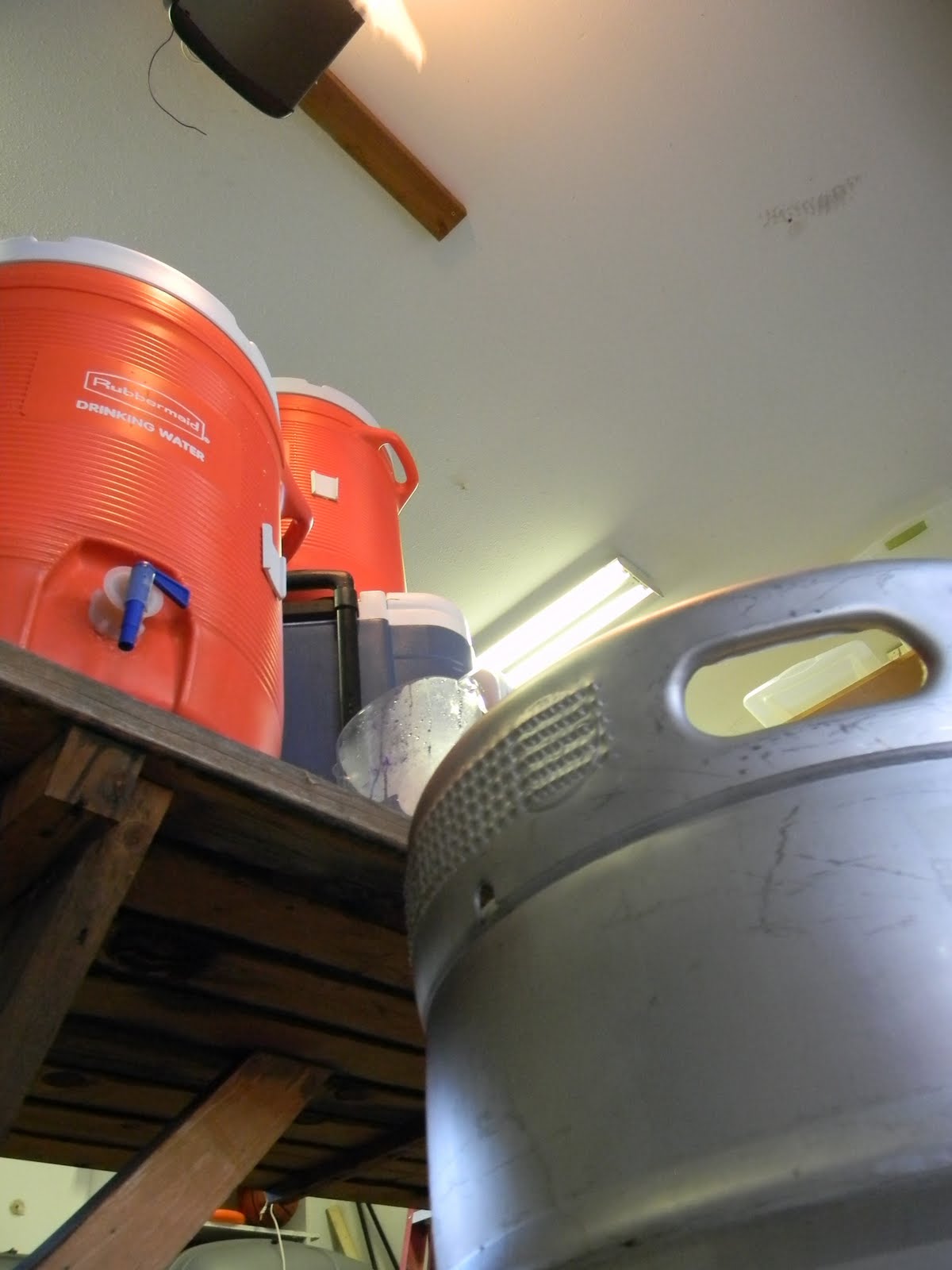
I brewed my first all-grain brew today and it was a blast! Taking it out of the kitchen throws brewing into a whole new dynamic for me. I was able to have the space I needed and the ability to clean up as I would in a real brewery, with a hose. I started by cleaning my new keggle by heating up water on the propane burner and then adding a few tablespoons of PBW into solution. I then drained that into my fermenters to set for a while. After rinsing the keggle I heated up 7.5 gallons of water to 160F and then transfered into my mash tun. I then added the grains and let sit for about an hour. The temp from beginning to end stayed exactly at 150 F, which is amazing in my opinion.


I performed an Iodine test to check for saccharification by draining a few drops of wort into a plastic tupperware container and then setting into a dish of cold water to cool down. Iodine turns black in the presence of starch, so if there is no color change then your enzymes have successfully converted all the starch into sugar. At first the iodine turned light red, so I let the mash keep going for a few more minutes and checked again. When I did my final test there was no color change so it was time to vorlouf. I did this by slowly draining the wort into a pitcher and slowly pouring it back on top of the mash.


The next step is sparging the grains. I heated up 5.5 gallons of water to 175F and then transfered into the HLT which was elevated above the mash tun. Drained the wort into the keggle until there was about a half inch of wort still present on above the grains, then it was time to start the sparge. I was left with 12.5 gallons of wort in the keggle.


From here it is all the same as before. only I boiled eight gallons instead of two.

It took only about an hour to reduce from 212 F to 70F


And we WAIT..........


We had a bit of a mistake when it came to emptying the keggle into the fermentors, the moral of the story here is that you should always check your spigots and fittings. I did not check the o-ring on my hop strainer in the keggle, it fell apart and got clogged, and then the spigot I chose for one of my fermentors fell off leaking a bit of wort on the ground. All in all it was the best brew ever and I feel much more confident in my skills and in what I have learned from the world brewing academy. I could feel what was taught to me being properly used.


Thursday, February 10, 2011

Siebels Course: Water the universal Solvent

I have completed modules 1 - 9 which span from brewing history, biochemistry, brewing water, all the ingredients to making beer, mashing, lautering and evening malting. This course is awesome so far and the tutors are very quick to respond to any question you might have. Some of the best things I have learned but not yet applied to my homebrew:

I will start with water for now and then try and update a with other lesson overviews

Testing my water for its pH and salt levels. The pH is a measure of the concentration of calcium and magnesium salts in your water. With this being said you can alter the pH of your water by adding different salts like gypsum into water brewing water before mash in order to give the enzymes proper acidity to do their job. The target pH range for your mash is going to be 5.2-5.6. Any higher you are risking a stuck fermentation, lose of malt enzyme activity, hard taste and a lower extract from your malt.
I would also love to be able to filter out the chlorine once again but our sink will not fit a PUR filter or any other adaptor and I'm not about to go buy a charcoal filter. Another alternative is to just let your water sit out over night and the chlorine should evaporate out. I checked with the city water and our water is hard but not hard enough for most breweries in town. Other than adding a little gypsum, baring weather or not I was trying to replicate a certain style (like pilsner from pilsen, or burton on trent) the water in Bend is pretty awesome. As a partial grain homebrewer, like most I have not really given much thought towards my water. When In Boone I used purified spring water in the kettle and I did not do a mash because I did not and still don't have the equipment for all-grain. Cory if you are reading this, did you do any kind of water adjustment while in Boone for your mash?
In Portland, I bought a PUR filter and used that for the kettle, and since I moved to Bend, I have just used the tap water without any adjustment. As soon as I get the equipment I will pay more attention to my brewing water. But for now I think I should be fine. So far I have learned a lot of good techniques on how to remove carbonates from your water, how to reduce water consumption (there is about 6 hl of water used per hl of beer sold in a brewery), and how water reacts with other molecules. Water is a universal solvent meaning that it has a negatively charged O atom and two positively charge H atoms. This is helpful in the brew house when it comes to adding your brewing salts for example.

Cheers

Tuesday, December 21, 2010

Racking the Hop Mound

I racked the Hop Mound (Previously known as the Red Riding hop, but got a name change when the beer did not turn out red at all and instead had a huge hop mound inside the fermentor) today yesterday into my secondary fermentor and I lost 1/2 gallon of beer in translation. I am not surprised at this due to the amount of whole leaf hops that were added to the primary fermentor. First judgement of smell is reminiscent of a floral bouquet with a slight bitter scent to it. The beer will be transfered to my cleaned and sanitized keg tomorrow while we are brewing up the recipe that Matt and I put together the other day.

I put the Siebels admission letter in the mail today. So as long as snail mail during the holidays doesn't let me down, I will soon be on my way to beginning the second step in building my beer empire.

HORRAY

Cheers to Beers