Showing posts with label Brew Day. Show all posts

Thursday, April 28, 2011

Day after Easter brew aptly named, Jesus "Ryes" Us


Jesus "Ryes Us


Water
start with 13 gallons of water, to end with 8 gallons in the fermenters. The water was left out for a few hours to try and evaporate the chlorine. The original pH is 5.

Grainbill
14 lbs of 2 row base malt
1 lb of crystal 10L
1 lb of crystal 20L
0.5 lb of crystal 40L
2 lb of malted rye

7.3 Lovibond

Hops
2 oz of Golding, 5.7AA @ 60 min
2 oz of Amarillo, 11.2AA @ 20 min
2 oz of Saaz, 3.2AA @ 5 min

Two Yeast strains into two different fermenters both with 4 gallons in them:
American Ale 2
Belgian witbier

No adjuncts
Irish moss at 15 minutes

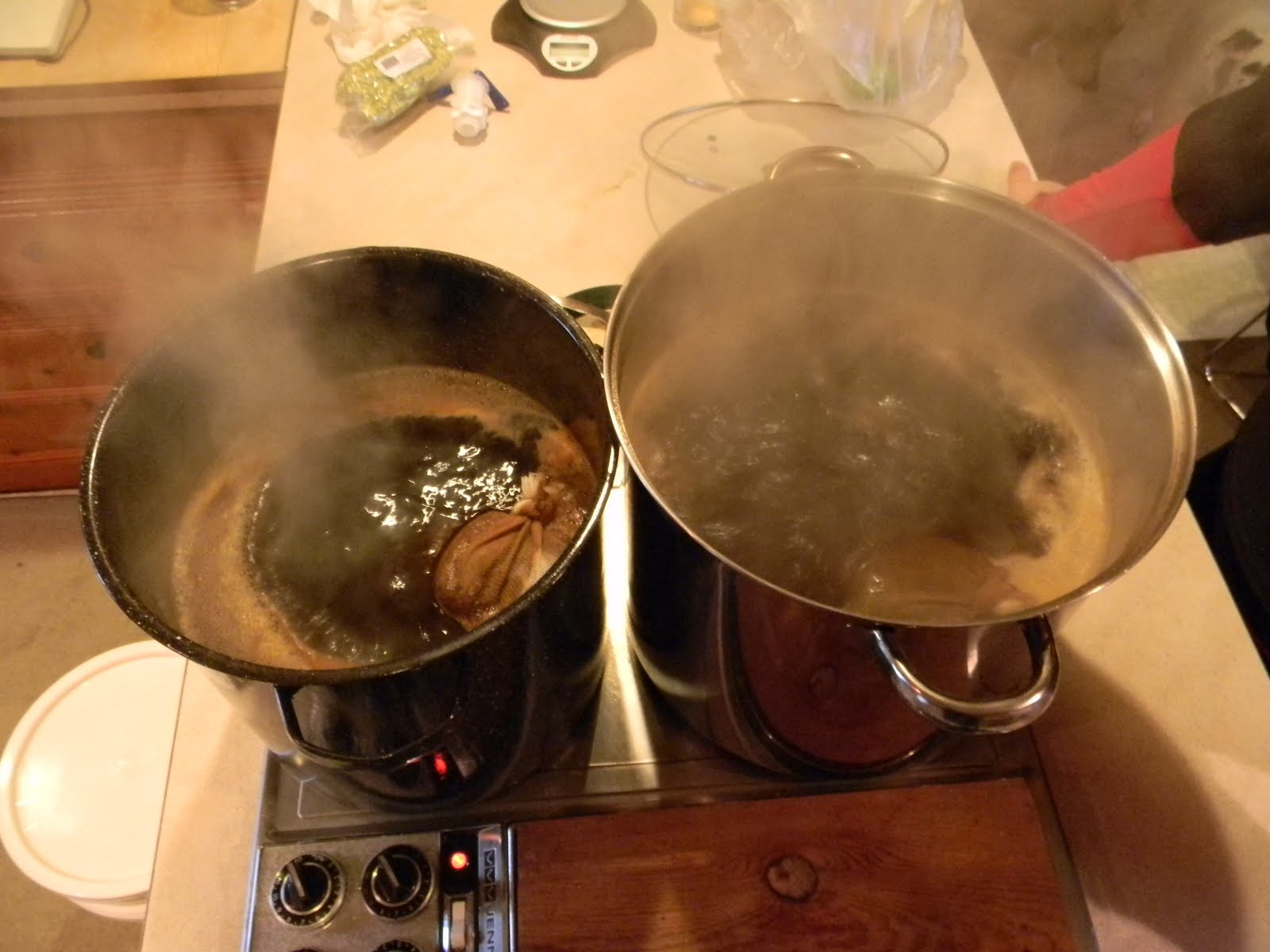
I brewed my first all-grain brew today and it was a blast! Taking it out of the kitchen throws brewing into a whole new dynamic for me. I was able to have the space I needed and the ability to clean up as I would in a real brewery, with a hose. I started by cleaning my new keggle by heating up water on the propane burner and then adding a few tablespoons of PBW into solution. I then drained that into my fermenters to set for a while. After rinsing the keggle I heated up 7.5 gallons of water to 160F and then transfered into my mash tun. I then added the grains and let sit for about an hour. The temp from beginning to end stayed exactly at 150 F, which is amazing in my opinion.


I performed an Iodine test to check for saccharification by draining a few drops of wort into a plastic tupperware container and then setting into a dish of cold water to cool down. Iodine turns black in the presence of starch, so if there is no color change then your enzymes have successfully converted all the starch into sugar. At first the iodine turned light red, so I let the mash keep going for a few more minutes and checked again. When I did my final test there was no color change so it was time to vorlouf. I did this by slowly draining the wort into a pitcher and slowly pouring it back on top of the mash.


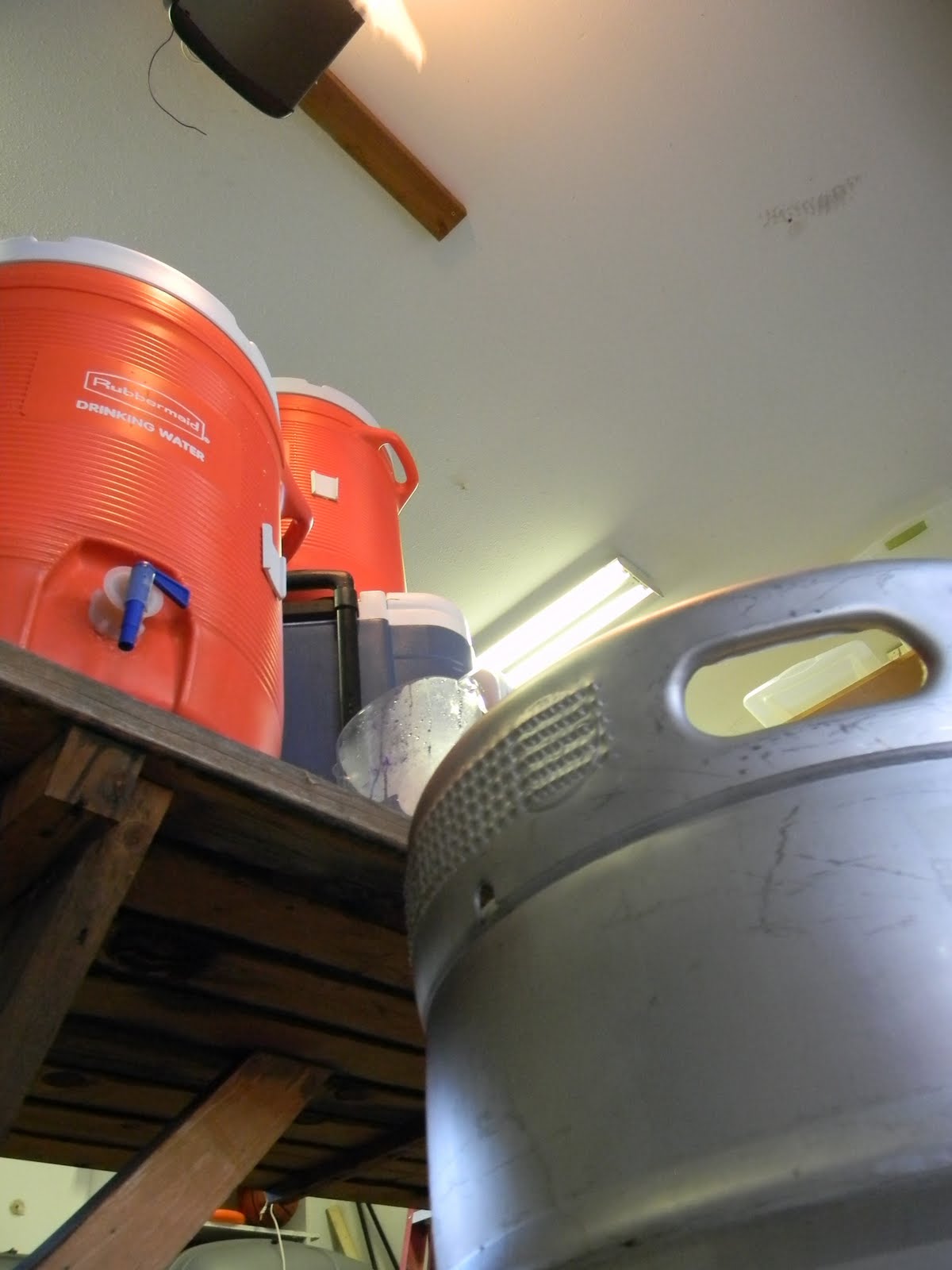
The next step is sparging the grains. I heated up 5.5 gallons of water to 175F and then transfered into the HLT which was elevated above the mash tun. Drained the wort into the keggle until there was about a half inch of wort still present on above the grains, then it was time to start the sparge. I was left with 12.5 gallons of wort in the keggle.


From here it is all the same as before. only I boiled eight gallons instead of two.

It took only about an hour to reduce from 212 F to 70F


And we WAIT..........


We had a bit of a mistake when it came to emptying the keggle into the fermentors, the moral of the story here is that you should always check your spigots and fittings. I did not check the o-ring on my hop strainer in the keggle, it fell apart and got clogged, and then the spigot I chose for one of my fermentors fell off leaking a bit of wort on the ground. All in all it was the best brew ever and I feel much more confident in my skills and in what I have learned from the world brewing academy. I could feel what was taught to me being properly used.


Thursday, March 3, 2011

Cascadian Juniper Ale


New Brew Set-up!!

Old Brew Set-up!!

We made more beer! This time I borrowed a friends 5 gallon pot, overfilled it and then had to split the batch up; 3 gallons in the 5 gallon pot and then 1.5 gallons in my two gallon pot. It was a hassle having to split up the ingredients and the boil so I got inspired to go and get myself a new kettle. I purchased a new keggle from a guy how makes them in town. It was a very good price for what I got and it has never been used before. It is a 1/2 BBL kettle with hop screen/false bottom attached to a 1/2 inch spigot about 3 inches above the bottom.


This will help facilitate in removing the hop particles as well as the hotbreak and some of the cold break too since I will be chilling in my kettle when it all said and done. There is also I nice thermometer attached the side in the middle of the kettle. This this is perfect for my cause. I also bought a 58,000 BTU propane burner and stand to get the job done. I can efficiently make a 10 gallon batch now.


To upgrade to a complete AG system I need to purchase a Mash Tun and Hot Liqour Tank. That can be done with getting two 10 gallon round Igloo coolers. I have seen people using rectangular coolers but I must disagree with using these as a mash-tun because when you stir your grains you are going to risk damaging the hulls as well as aerating the extract within if there are angles inside the vessel. You also want there to be a homogenous creation of a grain bed and a homogenous surface area for your filter. That is why false bottoms are circular and take up the entire bottom of the grain bed in commercial breweries.

So on to the recipe:

6.6 Lbs of Liquid Dark Malt Extract
3 Lbs of Dried Dark Malt Extract
(added after boil)

.25 Lb of chocolate Malt
.25 Lb of caraffa
.5 Lb of crystal 120 L
(steeped at 150 for 20 minutes, brought up to 165 and removed)

Hop/adjunct Schedule:

2 oz of domestic cluster pellets (6.9% AA) at 60 minutes
2 oz of cascade 2010 whole leaf (8.6% AA) at 15 minutes
1 tsp of Irish moss at 15 minutes
.5 oz of crushed juniper at 15 minutes

2 oz amarillo 2010 whole leaf (11.2% AA) into funnel and then the kettle was drained on top of this hop filter and into the fermenter where it was chilled. I got it down to pitching temp in 25 minutes and I had a 4 gallon boil. There was snow outside though so that helped.
I used Northwest ale yeast and pitched at 60 deg F which is a little lower than I would have liked. Also I do not feel as if I aerated enough before pitching due to a long Lag phase with in the first two days of fermentation. The lag phase is where the yeast are getting used to their environment and are using up the rest of the Oxygen present to respire and grow in their new environment. If there is not much O2 present (8 ppm is optimum) then there is going to be a longer growth phase in order to get the yeast to the proper amount for fermentation. In homebrewing this is something good to remember:

It will take 30 flips of the fermenter in order to get the proper amount of dissolved Oxygen in your wort. What this means is that if you take your glass carboy and flip it upside down 30 times, the headspace inside the fermenter will give you the amount of oxygen in your wort that you need. This is not possible so the alternative is to splash the wort into the fermenter vigoursly and then to stir for about 5 minutes.

Point being.........aeration is very important in the fermentation process.


Ahh Nature

Wednesday, December 22, 2010

I think we over did it


We made a brew tonight that was put together by Matt and I. We went down to the Homebrew store and made the magic happen. Here is where we picked up some delicious hops, barley and yeast. MMmmm MMmmmm, tasty. NO but for real, the hops we got are some of the best and most flavorful strains out there.

OG 1.062
IBU 120
SRM 11


Grain Bill
3.3 LBs of Liquid Pilsen light Malt Extract
3 LBs of the Light DME
1 LB of Crystal 60
.5 LB of Crystal 80
.5 LB of Carapils

Hops
2 oz of Sirachi Ace (10.1 AA)
2 oz of Columbus (15.8 AA)
2 oz of Willamette (5.4 AA)

Boil Schedule for a partial mash brew

bring two gallons of water to 160 degrees F and then remove from heat and add the speciality grains in the muslin bag.

Steep for 30 minutes and then remove and sparge with 170 deg F water.

Bring to a boil and then add the DME and LME

Start doing the hop thing
1 oz of Columbus (15.8 AA) continuously hopped starting at 60 minutes and ending at 30 minutes

1 oz of Sirachi Ace (10.1 AA) @ 30 minute

Addition of 2 tsp of Irish Moss

1 oz of Columbus (15.8 AA) continuously hopped starting at 30 minutes and ending at 15 minutes.

Combined the rest of the Columbus, 1 oz of Sirachi Ace and 2 oz of Willamette (5.4 AA) in a bowl and started to continuously add until 5 minutes, then we dumped the rest into the kettle for the remainder of the boil.

We then strained the whole mess into the bottling bucket and collected the hops into a muslin bag and put them into the now 5 gallon chilled mixture and let them sit there for 10 minutes while we brought it down to pitching temperature.

Poured the concoction into the primary fermentor and added the yeast.


VIOLA we have beer

PRAISE BE TO THE GOD OF HOP

Friday, December 10, 2010

Over Hopping, Shmover Shmopping.

We made a good looking beer tonight. The more I brew the more of a system I am getting down to keep me from spilling sanitizer all over myself in the bath tub. We developed the recipe around using the hops we had in the freezer, and since we had 6 ounces in there this is going to be a very hoppy red ale, appropriately name Red Riding Hop.


Grain Bill:

3 LBS of Light DME
3.3 LBS of Liquid Pilsen Malt Extract
.5 LBs of Dark Caramunich 120L
.5 Carapils
3 Oz of Red Wheat
4 Oz of Crystal 40L

Hop Schedule:

1 Oz of Goldings 5.7%AA continuously hopped between 60-30 minutes
1 Oz of Fuggles 6% AA continuously hopped between 30-0 minutes
1 Oz of Northern Brewer 9.9%AA at 5 minutes
1 Oz of Northern Brewer 9.9%AA into primary fermenter along with yeast
1 Oz of Northern Brewer 9.9%AA into (either primary, secondary or keg haven't decided yet.


We started with:

Smack the yeast pack

Heating 2 gallons of water up to 160 F and removing from heat

When you add grains to water this temperature it will bring the water down to the desired temperature which is 150F.

Add in the specialty grains inside the muslin bag and let sit for 25-30 minutes at 150F

Heat 1/2 gallon of water to 175 F in a separate kettle

THE COMMAND CENTER

Once the timer goes off for the grains in the main kettle raise them out of the kettle and pour the water from the second kettle on them, sparging the grains

Compost Grains somehow, or throw them away if you do not like the environment

Add the bag of DME

Bring to a boil and then add the container of Liquid Malt Extract


Bring to a boil again and start cleaning and sanitizing the primary fermentor, bottling bucket, big funnel, strainer, large 1 inch tube for blow off, small 1/4 inch tube for transferring, and the copper coil wort chiller.


Start adding the hops a pinch at a time, I decided to do this the entire boil to see what kind of effect I get. We started with Goldings for the first thirty minutes and ended with Fuggles for the last thirty minutes. Once there are five minutes to the end of the boil add 1 ounce of Northern Brewer.

RELAX DON'T WORRY HAVE A HOMEBREW


When boil is over, strain the two gallons of wort into the bottling bucket using the strainer, pour cold water on top of the hops in the strainer until you reach 5 gallons.

Chill with chiller some how that does not require a lot of towels.

Transfer to primary using large funnel. Place 1 ounce of Norther Brewer into the funnel and strain wort through them and push the hops into the fermentor as well. I know that CO2 has a "scrubbing" effect on the aroma of the hops. So usually you will put the hops in the fermentor either into secondary or four days after addition of the yeast when CO2 production has reduced a bit. If you put the hops to far after fermentation has ceased you risk oxidizing your beer later down the road especially if you use whole leaf hops because they contain a certain amount of air. So since there is a certain amount of air in the whole leaf hops, and you want to aerate you wort as much as possible before addition of yeast, i figured if you add the whole leaf hops along with the yeast then they will get more air into the fermentor.


Add Yeast, and blow off tube.

Put somewhere covered and around 64 F.


We got the wort down to temperature in less than 15 minutes. Which is great! I did not get a proper gravity reading because the concentration was too thick and read 1.2. Not sure this is right because I was shooting for 1.06 and 1.2 is dangerously high.

The next day, today, saturday the 11th we woke up to the sweet sound of fermentation.

So now we are planning on either adding another ounce of Northern Brewer into the primary in four days, or into the secondary or into the keg itself.


LIFES AN EXPERIMENT
DRINK UP


CHEERS TO BEERS


Monday, November 22, 2010

Fire Dancer......or some other catchy name for a beer

Also, BIG NEWS: We found a chest freezer!


This is the second brew at the new house. We went to the homebrew store today and put together a recipe from scratch (just like a pie). This is going to be a good one and we made some interesting changes to the process. This was actually the easiest brew I have ever done and it was also the most expensive.

Heres the ingredients:

Grain Bill
6 lbs of DME for the base
2 lbs of Crystal 80 L
10 oz of Victory 25 L
5 oz of Roasted 300 L
5 oz of Chocolate 350 L
5 oz of Quaker Oats

All Whole Leaf
1 oz of Goldings
1 oz of Fuggles
1 oz of Northern Brewer (aromatic)

Yeast
Wyeast 1187: Ringwood Ale Yeast

We put the speciality grains into a reusable muslin bag and let sit in 150 degree water for 25 minutes and then we added the rolled oats for another 10 minutes. We took all of the grains and oats out after a total of 35 minutes and composted.
We added the 6 lbs of DME and then brought back to a boil and we started to add the hops. I took 1 oz of Goldings and1 oz of Fuggles and put them together on a plate and then starting with the boil we added hops constantly for 30 minutes, putting about a teaspoon in at a time.

At 15 minutes I added 1 lb of Brown Sugar to bring the SG up a bit.

At 5 minutes we added 1 oz of Northern brewers hops.

we strained the wort into the bottling bucket and topped off with 3 more gallons of water. Good thing it was snowing because I used the snow out side and made a little igloo to facilitate chilling. A combination of the 20 degree weather, the snow and the wort chiller, we got the wort down to pitching temp in 30 minutes.

This is how I aerate my wort, I let gravity do the hard work.
We used Ringwood ale yeast because it has a high flocculation and will provide a malty complex profile.

We got a SG of 1.07 which is dangerous. If all goes well we end up with around 7.8%


Monday, October 25, 2010

Bend Brew Day One: I shall call it "Artisan Pumpkin Ale"


Tis the season for one of my favorite recipes of the year. This is my first brew at the new house but with the same set up I have been using all along.


I have a two gallon kettle on an electric range (for now, soon to upgraded to a ten gallon kettle on a gas outdoor stove).


So first things first, I collected my ingredients from the local homebrew shop a few days ago.
6 lbs of Light Dried Malt Extract
1 lb of crushed Carapils
1 lb of Crystal 60 L
1 Bag of wyeast 1056: American Pale Ale Yeast (the same Sierra Nevada Brewery uses)
2 oz of Willamette whole leap hops, gotta love the Northwest.

In addition since this is my artisan pumpkin ale I also will use these ingredients, i have not decided what order or in what amount yet:
2 small pumpkin pie pumpkins (7 lbs)
4 cans of pumpkin pie filling
1 tsp of cinnamon
1/2 tsp of nutmeg
1/2 tsp of ginger
1/2 tsp of corriander

I checked to make sure I have all the necessary equipment:

kettle.........check
Ingredients..........check
iodophor and star-san for sanitation.............check
Muslin bags for my speciality grains and pumpkin.........check
timer........check
good thermometer.......check
big ass funnel...........check
glass carboy and carboy rack for drying..........check
carboy brush........check
sanitizer bucket.........check
tasty brews to down while making some tasty brew..........check

This will be a 6o minute boil, I do use a wort chiller and I will do a two stage fermentation. I predict this beer will take around 1 week in primary fermentation and then another week in secondary until i transfer into my keg. By then I hopefully will have my kegerator built ( I still need a fridge if you know anyone).

I start this brew by roasting 7 lbs of pumpkin pie pumpkin that I sliced into large pieces in the oven at 350 degrees for one hour. I sprinkled brown sugar ontop just for good measure. This was not enough pumpkin, I wanted 5 lbs and I ended up after I stripped the skin off with only 3 lbs so I supplemented with 4 cans of organic and preservative free pie mix.
Add the pumpkin mixture with the speciality grains into a kettle with 1.5 gallons of water and heat to 150 and try to keep it at that temp for 1 hour. By all means you have to keep it under 170 F.
You then take this and strain it into a separate bucket and then sparge the mixture with 1 gallon of water with170 F water.
Take this and put back into the kettle and bring to boil. Add your 6 lbs of DME, and when it comes to a boil add 1 oz of willamette whole leap hops. While your wort is boiling, start sanitizing your stuff. remember that everything that comes into contact with your wort after the boil is over needs to be sanitized.
At 55 minutes add the spice mixture and another ounce of willamette whole leap hops.
At 60 minutes cut the boil and remover from heat
Try your best to get the wort down to temperature (70 F) as soon as possible with either a wort chiller or an ice bath
Aggressively shake to aerate the wort.
Add the yeast. I use a blow-off hose because I expect serious fermentation to happen.

I plan on adding one more small pumpkin to the secondary along with the same spice amounts that I added into the kettle.

cheers